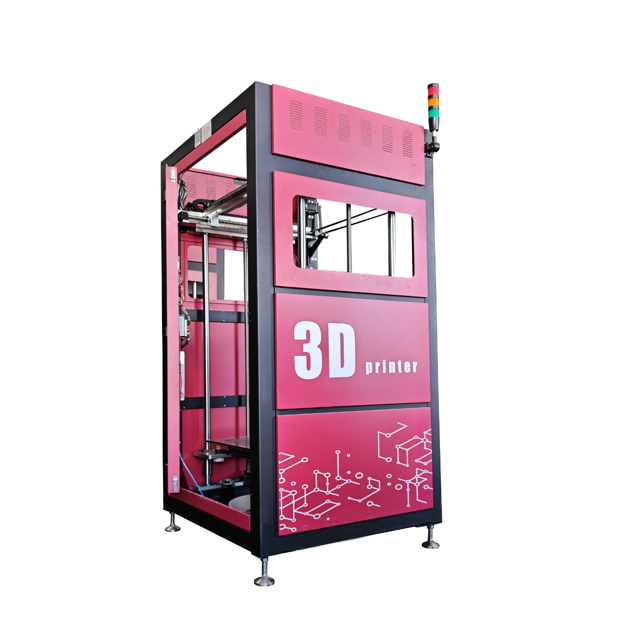
Complete Guide to Industrial FDM 3D Printing: From Prototype to Mass Production
In the world of additive manufacturing, industrial FDM (Fused Deposition Modeling) 3D printing has evolved from a rapid prototyping tool into a full-fledged production technology. For businesses seeking to manufacture functional end-use parts, industrial fixtures, and customized components at scale, understanding the capabilities and limitations of large-format industrial 3D printing is essential for making informed manufacturing decisions.
What Makes Industrial FDM Different from Desktop 3D Printing?
While desktop FDM printers have democratized access to 3D printing, industrial-grade FDM systems operate on an entirely different level. The distinction goes far beyond print size — it encompasses precision, reliability, material quality, throughput capacity, and the ability to deliver consistent results across production runs of hundreds or thousands of units.
Key Differences at a Glance
| Aspect | Desktop FDM | Industrial FDM |
|---|---|---|
| Build Volume | Typically 200-300mm | 600×600×1200mm+ |
| Precision | ±0.1-0.2mm | ±0.05-0.1mm |
| Uptime | Intermittent use | 24/7 continuous operation |
| Material Control | Commercial filaments | In-house formulated & produced |
| Throughput | 1-2 parts/day | Hundreds of parts/day |
| Quality Consistency | Variable | ISO-level consistency |
| Support | Community/self | Dedicated engineering team |
The Power of Large Build Volume: Why Size Matters
One of the most transformative advantages of industrial FDM printing is the maximum build volume. Our industrial printers support build volumes up to 600×600×1200mm, enabling one-piece integral printing of massive components that would be impossible — or prohibitively expensive — to produce through traditional manufacturing methods.
Applications Enabled by Large-Format Printing
Oversized Industrial Components
Housings, enclosures, and structural frames for machinery can be printed as single pieces, eliminating the need for secondary assembly, joining hardware, and the weak points that inevitably occur at joints.
Custom Jigs & Fixtures
Manufacturing aids such as assembly jigs, welding fixtures, inspection gauges, and ergonomic workholding devices benefit enormously from the ability to print them at actual size without compromise.
Architectural & Design Prototypes
Architects, product designers, and automotive stylists can evaluate full-scale or near-full-scale models, catching proportion and fitment issues that would be invisible at reduced scale.
Low-to-Medium Batch Production
For production quantities ranging from dozens to several thousand units, industrial FDM offers compelling economics compared to injection molding (which requires expensive tooling with $10,000-$100,000+ upfront investment) and superior geometric flexibility compared to CNC machining.
End-to-End Industrial 3D Printing Service
A truly comprehensive industrial 3D printing service extends far beyond simply pressing “print” on a machine file. The value chain encompasses multiple critical stages:
Stage 1: Digital Model Reception & Optimization
The process begins when you submit your CAD files (STEP, IGES, STL, OBJ formats accepted). A professional engineering team reviews your model for printability assessment, orientation optimization, structural analysis, wall thickness verification, and support structure minimization.
Stage 2: Material Selection & Customization
With in-house filament production capability, industrial providers offer material customization that off-the-shelf filaments cannot match:
- Custom material formulas tailored to specific mechanical requirements
- Precise color matching to brand standards or existing components
- Specialty additives: carbon fiber reinforcement, flame retardants, UV stabilizers, impact modifiers
- Hardness adjustment for TPU (Shore 60A-95D range available)
Stage 3: High-Precision Printing
Industrial printers operating under controlled environmental conditions deliver dimensional accuracy of ±0.05-0.1mm, consistent layer adhesion, real-time monitoring, and optimized toolpath generation using proprietary slicing software.
Stage 4: Post-Processing & Quality Inspection
Post-print processing transforms raw prints into finished products through support removal, surface finishing, dimensional inspection, mechanical testing, and documentation for regulated industries.
Stage 5: Global Logistics & Delivery
Completed parts are carefully packaged and shipped worldwide via established freight partnerships, with tracking and insurance options available.
Industrial FDM vs. Alternative Manufacturing Methods
Industrial FDM vs. Injection Molding
| Factor | Injection Molding | Industrial FDM |
|---|---|---|
| Minimum Order Quantity | 5,000+ units economically viable | 1 unit to 10,000+ units |
| Tooling Cost | $10,000-$100,000+ | Zero tooling required |
| Lead Time (First Part) | 4-12 weeks (tooling) | 2-7 days |
| Design Changes | Expensive mold modifications | Instant — just update the file |
| Geometric Complexity | Limited by draft angles & undercuts | Nearly unlimited |
| Best For | >10K identical mass-produced parts | Prototyping, custom parts, <10K batches |
Rule of thumb: If you need fewer than 5,000 identical parts, or if your design is still evolving, industrial FDM is almost always more cost-effective.
Industrial FDM vs. CNC Machining
| Factor | CNC Machining | Industrial FDM |
|---|---|---|
| Material Waste | High (subtractive) | Low (additive) |
| Geometry Constraints | Limited (tool access required) | Minimal |
| Internal Cavities | Not possible | Fully possible |
| Lead Time | Days to weeks | Hours to days |
Common Industrial Applications Across Industries
Automotive & Transportation
- Custom interior trim panels and dashboard components
- Under-hood brackets and heat-resistant fixtures
- Prototype bodywork and aerodynamic testing models
- Tooling for assembly line production (jigs, fixtures, gauges)
Aerospace & Defense
- Lightweight structural brackets and mounting hardware
- Interior cabin components with flame-retardant materials
- Drone frames and UAV components
- Conformal tooling and composite layup molds
Manufacturing & Industrial Equipment
- Machine guards and safety enclosures
- Conveyor system components and guides
- Pneumatic fixture bases and manifold prototypes
- Replacement parts for legacy equipment
Consumer Products & Electronics
- Custom packaging molds and display stands
- Wearable device prototyping
- Enclosures for electronics with snap-fit features
- Ergonomic handles and user interface components
Getting Started with Your Industrial 3D Printing Project
Step 1: Prepare Your Files
Export your 3D model in STL, STEP, or OBJ format. If you don’t have a 3D model, provide 2D drawings, sketches, or reference photos — many providers offer modeling services.
Step 2: Define Your Requirements
Specify required material, quantity needed, tolerance requirements, surface finish expectations, and delivery timeline.
Step 3: Request a Quote
Professional providers will review your files, identify potential issues, suggest optimizations, and provide a detailed quotation.
Step 4: Review & Approve
Most providers offer digital renderings or physical sample parts for approval before committing to full production runs.
Conclusion
Industrial FDM 3D printing has matured into a reliable, versatile manufacturing technology capable of serving everything from one-off custom prototypes to sustained medium-volume production. By partnering with a provider that owns their entire technology stack — from printer design and filament production to professional modeling and proprietary slicing software — you gain access to unmatched flexibility, quality control, and cost efficiency.
Whether you’re developing a new consumer product, replacing obsolete machined parts with lighter 3D printed alternatives, or scaling from prototype to production, industrial FDM 3D printing offers a compelling path from concept to delivered part.
Ready to start your next industrial 3D printing project? Our large-format FDM 3D printing service supports build volumes up to 600×600×1200mm with 600+ self-manufactured industrial printers running 24/7. We provide complete solutions from digital model reception through global delivery. Contact us for a detailed quote on your custom manufacturing requirements.
Shop high-quality 3D printer filaments: Visit Our 3D Filament Store